
What Happens When People Gather: The Magic of Gathering
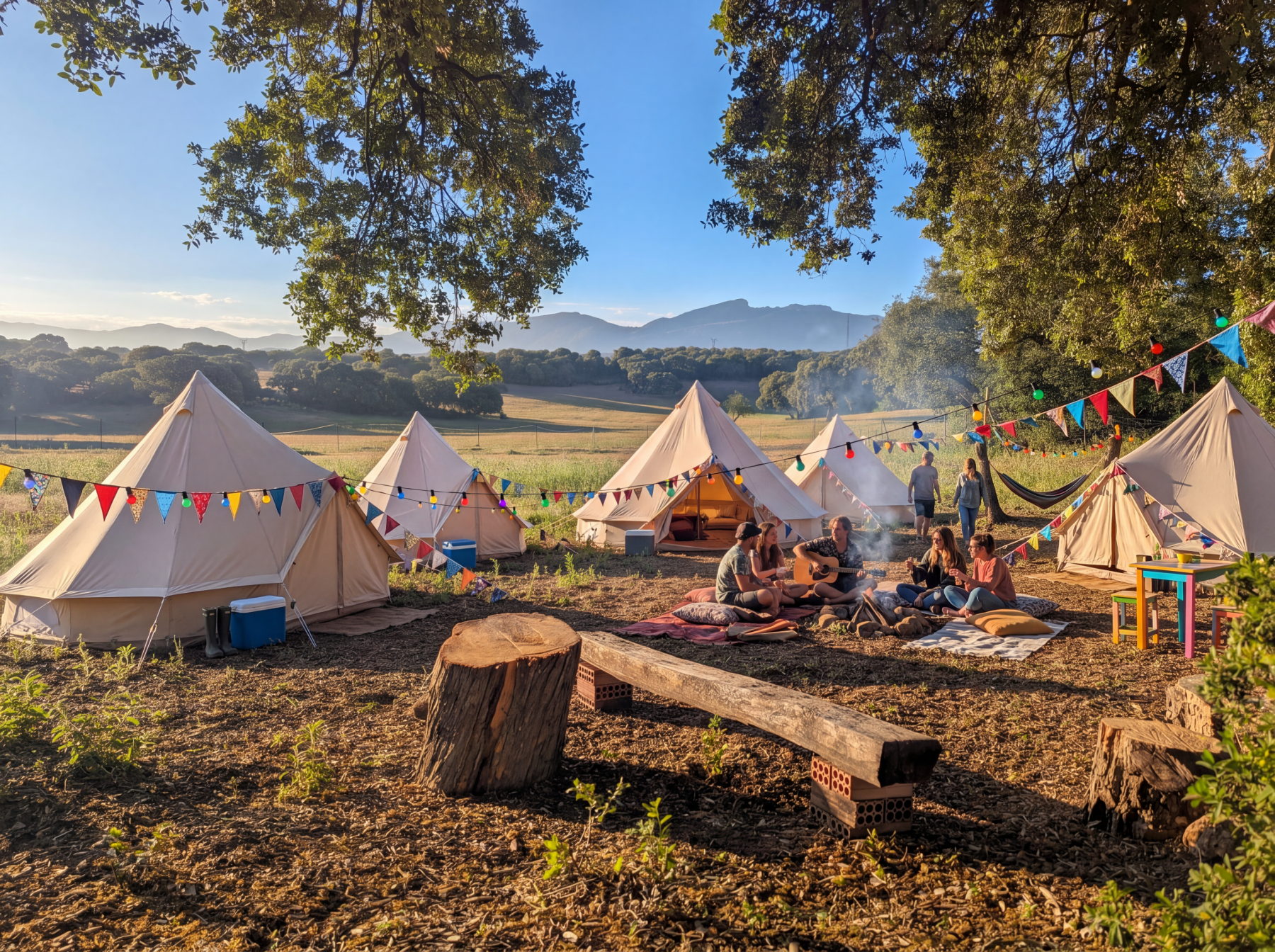
One of the most interesting things about festivals is that they are rarely remembered for the reasons expected.
Months or even years later, the timetable, workshops, or headline acts often fade into the background. What remains instead are fragments: a conversation at midnight, a meal shared with someone met only hours before, a shared moment on the dancefloor, a sunrise, a friendship that somehow continues long after the event has ended.
The things that stay with us are often the ones nobody planned.
Maybe this is because the real magic of a gathering sits somewhere between what is designed and what simply unfolds. Not in the stages, workshops, or structure of an event, but in something quieter beneath it all. A shift that is difficult to describe, but easy to recognise once it has been felt.
At a festival, arrivals carry the momentum of everyday life. They come from different places, with different routines, responsibilities, and concerns. Then, over the course of a few days, something begins to change. Conversations begin, encounters repeat, and familiar faces appear again in unexpected places. And without really noticing when it happened, a field full of strangers begins to feel like a place where you belong.
Festivals have always carried this quality.
On the surface they are temporary spaces, a few days carved out of ordinary everyday life. A whirlwind of music, food, conversation, time spent outdoors, and celebration. And then they dissolve again.
And yet people return to them, again and again. Not just for what happens on stage, but for what unfolds between everything else. Because in these environments, something different becomes possible. People arrive with permission to step outside their usual roles. The expectations of daily life loosen slightly, and with them, a different quality of interaction emerges. People become more available to each other. There is less distance, less self-consciousness, and more room for genuine connection.
There is something deeper too. When a shared environment is held with care, something begins to settle. The need to protect, present, and perform softens. And in that softening, presence becomes easier.
From there, everything tends to unfold a little differently. People stay longer than they planned. They join conversations they might normally avoid. They dance, participate, and take part more fully in what is happening around them. Connection stops being something to create and becomes a natural result of sharing the experience.
Community works in a similar way. It isn’t something you explain or define in the moment, instead, it is something you recognise through experience.
It is the moment someone passes a drink without being asked. A conversation that continues into the next day. The quiet realisation that what at first felt like a crowd of strangers has become strangely familiar. These are small things. But they accumulate. And over time, they form something that feels alive; a shared rhythm, an atmosphere, a field of experience.
Gatherings have existed for as long as we remember. Long before modern festivals, people came together around harvests, music, storytelling, ceremony, food, and shared celebration. The forms have changed, but the impulse remains remarkably familiar. We gather to mark moments, strengthen bonds, celebrate, and remember, if only for a little while, that life is something best experienced together.
Human beings are not meant to exist in isolation. Much of our wellbeing is shaped by the communities we belong to and the relationships we cultivate. Gathering offers an opportunity to reconnect with both. At a time when loneliness and disconnection have become increasingly common, that experience matters.
Festivals are a modern expression of that same ancient impulse. In many ways. They create a threshold between routine and possibility, where familiar patterns loosen and different ways of relating become possible. For a few days, expectations soften, and life is experienced from a slightly different perspective. Beneath the music and celebration lies something much older: the human need for ritual, belonging, and shared experience.
What may begin as a love of music often becomes something broader. Somewhere along the way, the event itself becomes less important than the atmosphere it creates. The experience shifts from entertainment to participation, from consumption to connection.
The best festivals create opportunities for chance encounters, unexpected friendships, moments of joy, and collective celebration. A kind of playground for adults, where curiosity, spontaneity, and connection are given room to emerge. Perhaps this is why festivals continue to matter. Not because they allow us to leave life behind, but because they reconnect us with parts of it that are often easy to forget.
In many ways, this idea sits at the heart of Sleeping Giants. Jordan often speaks about wanting to create a place that carried the feeling of "living at a festival all year long", not as constant activity, but as a quality of openness, spontaneity, and shared experience. The festival itself grew naturally from that intention.
Much of this is what draws people to gatherings like this. Not always consciously, but recognisably. A chance to connect, to celebrate, to be silly, to dance, to laugh, and to feel part of something larger than ourselves. In a world that often pulls us into routine and responsibility, these experiences remain both rare and meaningful. Not as an escape from life, but as a return to it. A reminder of what it feels like to be with others without performance, explanation, or the need to be anything other than present.
This is also why scale matters.
For its first edition, Sleeping Giants will be an intentionally intimate gathering, with a limited number of tickets available. What that creates is simple. It becomes harder to hide, but easier to meet. Easier to recognise faces, and easier to fall into rhythm with others. Easier to recognise faces, fall into rhythm with others, and allow connections to deepen across days.
We believe in the power of large-scale gatherings, and perhaps that will evolve in time. But there is something important about beginning here.
Smaller gatherings do not reduce intensity. They refine it. There is less noise, more space for spontaneity, and more room for encounters to land. Within that space, something subtle begins to form: a temporary community that feels coherent, even if only for a short time. Not because it is designed, but because it is small enough for people to genuinely feel each other.
Perhaps this is what gathering has always been about. Not the programme or the performances, not even the festival itself, but the simple possibility of coming together. Sharing music, movement, food, celebration, and a brief moment in time that feels larger than any one person.
Then everyone returns home. But something of the experience travels back with them: a friendship, a memory, a shift in perspective, or simply the feeling of having belonged somewhere for a while.
And maybe that is why people have gathered for thousands of years, and why they continue to gather now.
